



When Janet Naughton and I wrote the 2023 novel, The Crystal Ball Chronicles, about West Palm Beach’s murdering and embezzling postmistress, Lene Clarke, there was one significant research finding we couldn’t include in the book. Early on, our intention was to use the actual names of all the people involved in the case, at least the ones publicly identified in the newspaper.
In several articles in the Palm Beach Post, the Orlando Sentinel, and the Miami News, a man identified only as “J. L. King” was tied to Lena Clarke. He drove many times to Orlando to bring her clothing and other essentials from her family. He was a World War I Navy veteran and had worked for Lena Clarke as a mail carrier. King was also mentioned in Rev. Almon T. Clarke’s (Lena’s father) diary kept at the Historical Society of Palm Beach County, but again, only as “King” or “J. L. King.”
Looking further, I found the bill that attorney Charles C. Chillingworth had submitted to the family for Lena’s defense in the Orlando trial. It was an itemized bill for more than $10,000 (equivalent today to more than $150,000). One item was reimbursement for travel expenses to a “James L. King.” That was the key to unraveling who this mysterious friend of Lena’s was.
King was born in Georgia. His father, also a James Lawrence King, was a real estate developer in the Jacksonville area. King Jr. came south to West Palm Beach. Lena Clarke had hired several WW I veterans as mail carriers for the West Palm Beach post office, which was expanding home delivery in the 1920s. King Jr. became close with the Clarke family following the death of their son Paul Clarke from snakebite in 1920.
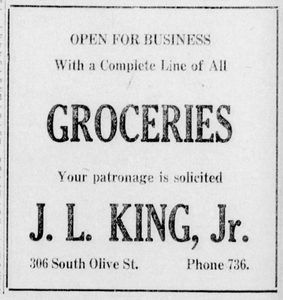
Because of his association with Lena Clarke, King Jr. was fired from his mail carrier job. In support of Lena, he attended her November 1921 murder trial in Orlando, where she was tried for the murder of a former postal employee, Fred Miltimore. After her not guilty by reason of insanity verdict, King Jr. remained in West Palm Beach and ran a grocery store on Olive Street. He and his father incorporated as “King Investments” in West Palm Beach in 1922.
One day I wondered what had become of James Lawrence King, Jr. I found he had moved to Homestead and married in 1925, welcoming a son in 1928. I wondered if the King family knew anything about King Jr.’s connections to Lena Clarke and could help me learn more about him. I found their family tree on Ancestry in 2023 and saw that James Lawrence King Jr. had died early, in 1938, at the age of 46, leaving his wife and young son. And then something curious. There was no death date listed for the son, who was also named James Lawrence King. Could the 95-year-old King III actually be alive? I googled the name “James Lawrence King” and “Miami.” I found he was very much alive.
He was the Honorable James Lawrence King, Senior Federal Judge of the U.S. District Court for the Southern District of Florida. In fact, the Federal Justice Building in Miami is named in his honor. I was stunned. And it was then that I knew I had to rename several characters in the book. J. L. King became Jim Keene in the book.
I wrote to Judge King in Miami and included several newspaper clippings about the incorporation and the Clarke trial. I knew I would need to provide evidence that his father had been involved in Clarke’s case. A few weeks later, my phone rang with “FEDERAL COURTHOUSE” on the caller ID. And there on the phone was Judge King. Over the next few months, we had several touching conversations about his father. He was of the last generation that still said “Miamah.” He knew nothing of the Clarke case nor that his father had lived in West Palm Beach. He was only nine when his father died, but he shared memories with me. During the 1935 deadly Keys Labor Day hurricane, his father packed his car with people escaping during the storm, being one of the last cars that made it out before the storm’s full onslaught. His father worked in real estate in Miami, often completing all the paperwork in the transactions, and knew as much as any attorney.
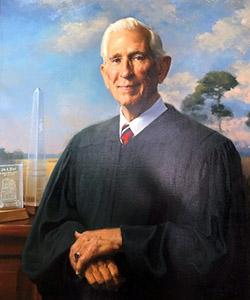
After King Jr. passed away, mother and son remained in Homestead. She often entered recipe contests, winning many, to help bolster the family’s income. A precocious student, King III had his own column in the Miami News when he was ten years old. He carried on to the University of Florida (UF), working each summer as a farm hand to save money to keep attending college. He graduated law school at UF and began his long legal career, being nominated for the federal bench in 1971 by President Richard M. Nixon (see King’s Wikipedia page – Click Here). One of his most noted decisions was that Mel Fischer was the rightful owner of the 1985 Atocha treasure find.
In the actual Clarke case, on August 1, 1921, Clarke hired a driver, Baxter Patterson, to take her to Orlando from West Palm Beach to meet up with Fred Miltimore, the man she would end up killing that evening. I have often wondered if she had first asked King Jr. to drive her to Orlando or if she wanted to shield him from being involved in what she had planned. Regardless, fate saved him from having been directly involved in Florida’s biggest scandal in 1921. Lena’s driver stood trial as well, but was found not guilty, as he had no knowledge of Lena’s plans.
I promised Judge King that this story would not be revealed in the book. Now, after his passing May 2, 2026, where he still served on the federal bench, this twisted piece of history can be revealed. There is always more to discover if you just keep digging.